

Pest Library
Black-Legged Deer Ticks
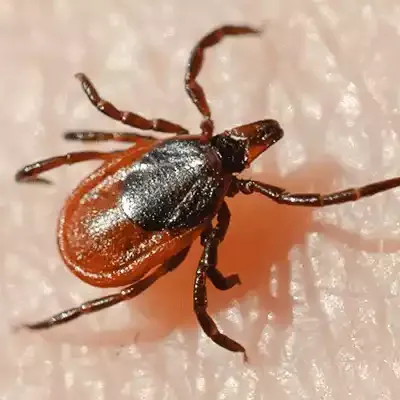
Black-legged deer ticks have brownish-orange bodies and distinctive dark legs. The "deer" name comes from their affinity for white-tailed deer, but they'll feed on people, dogs, cats, rodents, raccoons, and skunks just as readily. They're tiny and easy to overlook on yourself or your pets.
Are Black-Legged Deer Ticks Dangerous?
Black-legged deer ticks carry and transmit Lyme disease — a debilitating illness caused by bacteria the tick transmits through its saliva during a slow feeding process. The longer the tick stays attached, the more likely it is to transmit the disease.
As arachnids, they can't jump or fly — they crawl to the tops of grass and weeds and wait for a host to brush past, then hitchhike wherever that host goes.
Where Deer Ticks Wait in Your Yard
The most common places people and pets encounter these ticks are wooded trails, fields and meadows, and suburban or urban yards — anywhere with moisture, dense vegetation, and animal activity. Tap a zone below to see the risk.
Tap any glowing zone to see the tick risk there and how to reduce it.
Partner with Mosquito Busters to keep your property protected from black-legged deer ticks. The spread of Lyme disease by these ticks in our region is a real concern, and protecting your yard and family from contact with them matters.
We offer tried-and-true tick control methods that are affordable, highly effective, and always performed by specially trained technicians. To learn more about our reliable tick control services in Massachusetts or New Hampshire, give us a call today!
- After walking outside or spending time in wooded areas, always check yourself and your pets carefully for these small ticks.
- When walking on wooded trails, always stay at the center of the path.
- Keep the grass in your yard short and remove areas of dense or overgrown vegetation.
- Cut tall grass back away from fence lines, porch steps, and your home's foundation.
- Cut wooded areas back away from the perimeter of your property.
- Don't purposely feed wild animals on your property.
- Place your pets on a tick preventative program under the guidance of their veterinarian.
Learn more about our quality all-natural pest control products in Massachusetts and New Hampshire.