

Pest Library
Termites
Known as "silent destroyers," termites cause more than $5 billion in damage to U.S. homes every year and often go unnoticed until the damage is severe. In Massachusetts, where damp, humid conditions can be ideal for them, most homeowners' insurance won't cover the resulting damage.
What Are the Risks of a Termite Infestation?
Termites don't pose a direct health risk, but an infestation can lead to real problems indirectly:
- Allergic reactions: termite droppings or dust can trigger asthma, bronchitis, or other respiratory issues.
- Mold growth: infestations create moisture buildup that's ideal for mold, which can worsen allergies and asthma.
- Structural damage: termites can compromise a building's stability and create safety hazards.
- Contamination: infestations can contaminate food sources.
How Termites Get Into Your Home
Termites build intricate nests or mounds from soil and saliva, and some species build with mud or carton — a mix of soil, saliva, and feces. Tap a spot below to see how they typically reach a structure.
Tap any glowing spot to see how termites use it to reach your home.
Termites are highly social insects living in large colonies with specialized castes — workers, soldiers, and reproductive individuals. They have a unique ability to digest cellulose, the main component of wood, with help from symbiotic microorganisms in their digestive system. Ecologically, they play an important role as decomposers, breaking down dead plant material — but that same ability is exactly what makes them so damaging to wooden structures.
Given the scale of potential damage and the fact that insurance typically won't cover it, a suspected termite problem is worth having a professional inspect right away rather than waiting for visible damage.
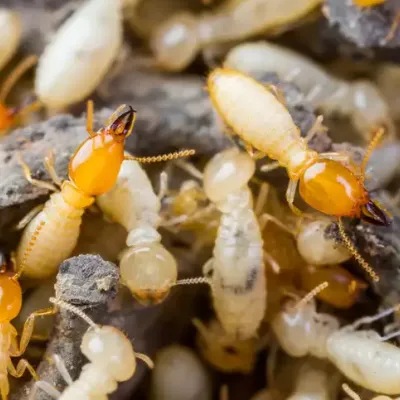
Termites are small, pale insects in the order Isoptera. They resemble ants in body shape but have straight, bead-like antennae and a broad waist without the narrowing you'd see on an ant. Their two pairs of wings are straight, narrow, and equal in size and shape — unlike an ant's more elongated, veined wings. Some termite species are wingless and darker in color. Termites also have straight mandibles, while ant mandibles curve.