

July 2026 Newsletter
From the Desk of Tom
Many of you have probably heard about the recent wastewater releases into the Merrimack River following the sewer line failure in Haverhill. It has certainly been one of the biggest local stories this summer, and naturally we've started receiving questions about whether events like this can increase insect activity.
The answer isn't always straightforward.
Standing water and areas with increased organic material can create favorable conditions for insects such as mosquitoes and flies. At the same time, weather patterns, rainfall, temperature, and available breeding sites all play important roles in determining insect populations.
What we do know is that we've experienced a warm, wet start to the summer, and those conditions alone can support higher populations of many insects throughout Massachusetts and New Hampshire.
It's a good reminder to take a walk around your property and eliminate standing water wherever possible. Clean your gutters, empty containers that collect rainwater, refresh bird baths regularly, and inspect low areas of your yard where water may linger after storms.
Small preventative steps today can make a noticeable difference throughout the rest of the summer.
As always, our goal is not simply controlling pests—it's helping homeowners understand why they're seeing them in the first place.
— Tom Drapeau
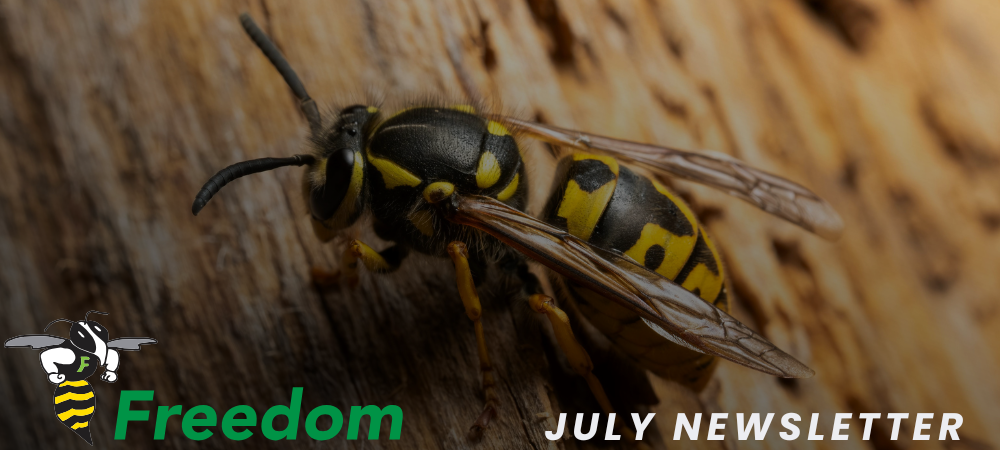
Pest of the Month: Yellow Jackets, Wasps & Hornets
July is when most homeowners begin noticing a sharp increase in stinging insect activity. What started as a single queen in the spring has now developed into a rapidly growing colony, and by midsummer these insects are busy expanding their nests and searching for food.
Although many people refer to them simply as "bees," yellow jackets, paper wasps, and bald-faced hornets behave very differently and require different approaches for safe control.
Yellow Jackets
Yellow jackets are responsible for the majority of stinging insect calls we receive during the summer. Unlike honey bees, yellow jackets commonly build nests:
- Underground
- Inside retaining walls
- Beneath landscape timbers
- Inside wall voids
- Under steps and patios
Because the nest entrance may be only the size of a dime, homeowners often discover it only after disturbing the colony while mowing the lawn, gardening, or playing in the yard.
Paper Wasps
Paper wasps build the familiar umbrella-shaped nests under:
- Deck railings
- Porch ceilings
- Door frames
- Window trim
- Children's playsets
They are generally less aggressive than yellow jackets but will defend their nest if disturbed.
Bald-Faced Hornets
Despite their name, bald-faced hornets are actually a type of large aerial yellow jacket. They construct large gray paper nests in:
- Trees
- Shrubs
- Utility poles
- Roof overhangs
By late summer, a single nest can grow to the size of a basketball and contain several hundred workers. Of the three stinging insects discussed here, bald-faced hornets are often the most defensive of their nests. If disturbed, they may leave the nest in large numbers and aggressively pursue what they perceive as a threat. For that reason, homeowners should never attempt to remove a large aerial nest themselves.
At a Glance
| Insect | Common Nest Location | Defensiveness |
|---|---|---|
| Yellow Jackets | Underground, retaining walls, wall voids | High |
| Paper Wasps | Decks, soffits, window trim | Moderate |
| Bald-Faced Hornets | Trees, shrubs, roof overhangs | Very High when defending the nest |
Prevention Tips
- Keep outdoor trash containers tightly closed
- Clean food and drink spills promptly during cookouts
- Keep sugary drinks covered when outdoors
- Inspect decks, sheds, playsets, and rooflines regularly for new nests
- Watch for repeated insect traffic entering the same location
- Keep children and pets away from any suspected nest
Frequently Asked Questions
Wildlife Watch: Birds Nesting in Chimneys
Every July we receive calls from homeowners who suddenly hear loud chirping coming from inside their chimney. Many assume a bird has become trapped or that bats have moved in.
In many cases, the visitors are actually chimney swifts. Chimney swifts are migratory birds that have adapted to nesting inside masonry chimneys after the loss of many of their natural hollow-tree habitats.
During nesting season, parents make frequent trips bringing insects back to their young, creating constant activity and loud vocalizations that can easily be heard throughout the home.
Signs to Watch For
- Birds flying in and out of the chimney throughout the day
- Continuous chirping from inside the chimney
- Increased bird activity near the roofline
An Important Reminder
Chimney swifts are protected under the Migratory Bird Treaty Act. If a chimney contains an active nest with eggs or young birds, it is generally illegal to disturb or remove the nest until the birds have naturally fledged.
Once the nesting season has ended, installing a properly fitted chimney cap is one of the best ways to prevent future nesting while still allowing your chimney to function properly.
Rat Population Watch
Summer often creates the impression that rat problems have disappeared. In reality, the opposite is occurring.
Our Rat Map continues to show the highest activity levels in larger cities throughout our service area, while suburban neighborhoods are beginning to experience more burrowing around sheds, retaining walls, foundations, and landscaped areas.
As communities place greater emphasis on Integrated Pest Management (IPM) and more selective use of rodenticides, long-term rat control increasingly depends on sanitation, exclusion, habitat reduction, and ongoing monitoring.
Food remains the driving force behind every rat population.
Unsecured trash, outdoor pet food, excessive bird feeding, compost piles, and dense vegetation continue to support expanding populations.
Signs of Rat Activity Around Your Home
- Fresh burrows near foundations
- Droppings around trash storage areas
- Gnaw marks on plastic containers
- Missing bird seed or pet food
- Grease marks along walls or fencing
Remember, fall doesn't create rat problems—it simply makes the growing summer population much more noticeable. Addressing conditions now can help prevent much larger problems later in the year.
This Month's Homeowner Tip
If you notice a steady stream of yellow jackets flying to the same spot in your yard or around your home, don't investigate too closely. They may be entering an underground nest through an opening no larger than a dime, or accessing a nest inside a wall, soffit, or other hidden void. Mark the area, keep children and pets away, and observe from a safe distance until the nest can be identified.
Not Sure What You're Seeing?
Summer brings increased activity from insects and wildlife throughout New England. Sometimes it's difficult to know whether what you're seeing is simply seasonal—or the beginning of a larger problem.
If you've noticed something unusual in your yard or on your home and you're not quite sure what it is, we're always happy to help. A quick question today can often prevent a much bigger problem tomorrow.
Learn more or request an evaluation by visiting our Home & Wildlife Resource Center.
Not Sure What You're Seeing?
Seasonal pest and wildlife activity is predictable — but it's not always easy to tell what's normal and what isn't. If something seems off, it's worth taking a closer look. Learn more by requesting an evaluation below!